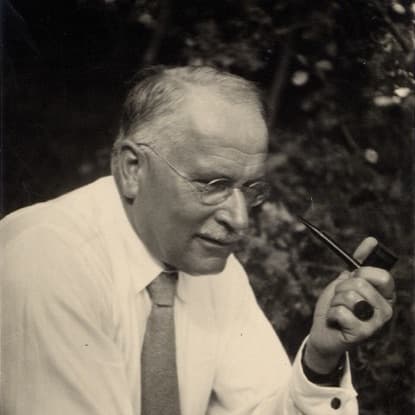
Carl Jung
Freud's heir, until he wasn't
Psychology
About
Jung was Freud's chosen successor until they split over whether everything comes back to sex. He went on to build his own vocabulary — the shadow, the archetype, individuation — and much of it has quietly entered ordinary speech. He is at his best on the parts of yourself you would rather not look at, and unusually humane about what to do once you have.
Read Jung when the thing you cannot stand in other people is starting to look familiar.
Philosophy
As is always the case, truth is found in the middle.
The Theory of Psychoanalysis, Ch. VIII: The Etiology of the Neuroses · 1915
Philosophy
The world is, in the first place, a subjective phenomenon.
The Theory of Psychoanalysis, Ch. VIII: The Etiology of the Neuroses · 1915
Psychology
To a child the moon is a man or a face or a shepherd of the stars.
Psychology of the Unconscious, Part I · 1916
Psychology
To understand the psyche causally, means to understand but half of it.
Collected Papers on Analytical Psychology, Ch. XIII: The Content of the Psychoses · 1917
Philosophy
The mind is a point of passage and thus necessarily determined from two sides.
Collected Papers on Analytical Psychology, Ch. XIII: The Content of the Psychoses · 1917
Philosophy
The way is difficult, and in the end all man ever attains to is relative truth.
Collected Papers on Analytical Psychology, Ch. IX: On Some Crucial Points in Psychoanalysis · 1917
Psychology
A person is only half understood when one knows how everything in him came about.
Collected Papers on Analytical Psychology, Ch. XIV: Foreword to New Edition · 1917
Philosophy
Man must be able to take pleasure in his life, or the struggle of life has no reward.
Collected Papers on Analytical Psychology, Ch. IX: On Some Crucial Points in Psychoanalysis · 1917
Philosophy
The world is as we see it and not simply objective; this holds true even more of the mind.
Collected Papers on Analytical Psychology, Ch. XIII: The Content of the Psychoses · 1917
Philosophy
The world of the artist is one of solved problems; the world of reality, that of unsolved problems.
Collected Papers on Analytical Psychology, Ch. XIII: The Content of the Psychoses · 1917
Psychology
There is altogether no better means of tyrannising over a whole household than by a striking neurosis.
Collected Papers on Analytical Psychology, Ch. XIV: Foreword to New Edition · 1917
Philosophy
The moral law is only an outward manifestation of the innate human impulse to dominate and tame oneself.
The Theory of Psychoanalysis, Ch. X: Some General Remarks on Psychoanalysis · 1915
Philosophy
Life is not made up of yesterdays only, nor is it understood nor explained by reducing to-day to yesterday.
Collected Papers on Analytical Psychology, Ch. XIV: Foreword to New Edition · 1917
Philosophy
Life along the line of least resistance is not synonymous with a man’s regardless pursuit of his own egoistic desires.
Collected Papers on Analytical Psychology, Ch. IX: On Some Crucial Points in Psychoanalysis · 1917
Psychology
The psychoanalyst must never forget that the final aim of psychoanalysis is the personal freedom and moral independence of the patient.
The Theory of Psychoanalysis, Ch. IX: The Therapeutical Principles of Psychoanalysis · 1915