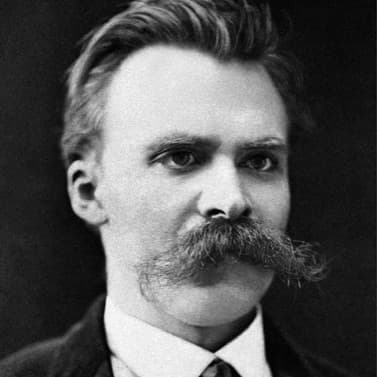
Friedrich Nietzsche
Wrote in dynamite, died in silence
Philosophy
Nietzsche was a professor of classics at twenty-four, an invalid by his mid-thirties, and insane for the last eleven years of his life. He wrote in aphorisms partly because his eyes could not stand long work, and the form suited him — each one is a charge set under something you believed. He is quoted more than he is read, usually by people he would have despised.
He who attains his ideal, precisely thereby surpasses it.
Beyond Good and Evil, Ch. IV, Aph. 73 · 1886
A nation is a detour of nature to arrive at six or seven great men.
Beyond Good and Evil, Ch. IV, Aph. 126 · 1886
To talk much about oneself may also be a means of concealing oneself.
Beyond Good and Evil, Ch. IV, Aph. 169 · 1886
He who despises himself, nevertheless esteems himself thereby, as a despiser.
Beyond Good and Evil, Ch. IV, Aph. 78 · 1886
If a man has character, he has also his typical experience, which always recurs.
Beyond Good and Evil, Ch. IV, Aph. 70 · 1886
The criminal is often enough not equal to his deed: he extenuates and maligns it.
Beyond Good and Evil, Ch. IV, Aph. 109 · 1886
There is no such thing as moral phenomena, but only a moral interpretation of phenomena.
Beyond Good and Evil, Ch. IV, Aph. 108 · 1886
If a man knows the wherefore of his existence, then the manner of it can take care of itself.
Twilight of the Idols, "Maxims and Missiles", Aph. 12 · 1888
A man of genius is unbearable, unless he possess at least two things besides: gratitude and purity.
Beyond Good and Evil, Ch. IV, Aph. 74 · 1886
The maturity of man--that means, to have reacquired the seriousness that one had as a child at play.
Beyond Good and Evil, Ch. IV, Aph. 94 · 1886
The charm of knowledge would be small, were it not so much shame has to be overcome on the way to it.
Beyond Good and Evil, Ch. IV, Aph. 65 · 1886
He who is a thorough teacher takes things seriously--and even himself--only in relation to his pupils.
Beyond Good and Evil, Ch. IV, Aph. 63 · 1886
The will to overcome an emotion, is ultimately only the will of another, or of several other, emotions.
Beyond Good and Evil, Ch. IV, Aph. 117 · 1886
The great epochs of our life are at the points when we gain courage to rebaptize our badness as the best in us.
Beyond Good and Evil, Ch. IV, Aph. 116 · 1886
To be ashamed of one's immorality is a step on the ladder at the end of which one is ashamed also of one's morality.
Beyond Good and Evil, Ch. IV, Aph. 95 · 1886
Read when a comfortable belief of yours needs testing to destruction