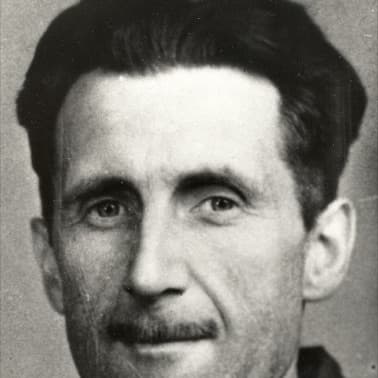
George Orwell
Plain English as a moral position
Philosophy
Orwell was a colonial policeman in Burma, a dishwasher in Paris, a shot-through-the-throat volunteer in Spain, and the most quoted political writer in English. His essays on language are the ones to read first: he argued that vague writing and political lying are the same habit, and that clarity is something you owe other people.
Read when you want to know whether a sentence is hiding something
- 01
Nationalism is power-hunger tempered by self-deception.
Notes on Nationalism (1945)
- 02
There is no such thing as a genuinely non-political literature.
The Prevention of Literature (1946)
- 03
The essence of being human is that one does not seek perfection.
Reflections on Gandhi (1949)
- 04
The whole idea of revenge and punishment is a childish daydream.
Revenge is Sour (1945)
- 05
If thought corrupts language, language can also corrupt thought.
Politics and the English Language (1946)
- 06
In our time it is broadly true that political writing is bad writing.
Politics and the English Language (1946)
- 07
The gods are jealous, and when you have good fortune you should conceal it.
Such, Such Were the Joys (1947)
- 08
If you simplify your English, you are freed from the worst follies of orthodoxy.
Politics and the English Language (1946)
- 09
Atrocities are believed in or disbelieved in solely on grounds of political predilection.
Looking Back on the Spanish War (1942)
- 10
The opinion that art should have nothing to do with politics is itself a political attitude.
Why I Write (1946)
- 11
Never use a metaphor, simile or other figure of speech which you are used to seeing in print.
Politics and the English Language (1946)
- 12
All writers are vain, selfish, and lazy, and at the very bottom of their motives there lies a mystery.
Why I Write (1946)
- 13
To an ordinary human being, love means nothing if it does not mean loving some people more than others.
Reflections on Gandhi (1949)
- 14
The controversy over freedom of speech and of the press is at bottom a controversy of the desirability, or otherwise, of telling lies.
The Prevention of Literature (1946)
- 15
No doubt alcohol, tobacco, and so forth, are things that a saint must avoid, but sainthood is also a thing that human beings must avoid.
Reflections on Gandhi (1949)