Plato
Everything after him is a footnote
Philosophy
About
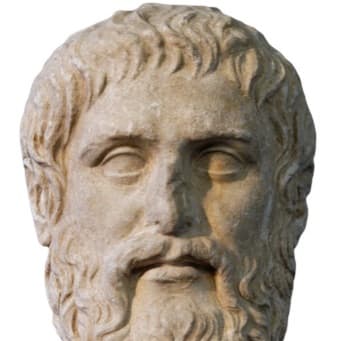
Plato watched Athens execute his teacher and spent the rest of his life arguing that the crowd should not be in charge of the truth. He wrote in dialogues, never in his own voice, which is why he can hold two positions at once and never quite be pinned down. The Academy he founded ran for nine hundred years.
Read Plato when you want to be argued with rather than agreed with.
Philosophy
The philosopher is a lover of truth and being.
Republic, Book VI · 375 BC
Philosophy
To do one's own business in a certain way may be assumed to be justice.
Republic, Book IV · 375 BC
Philosophy
The excessive increase of anything often causes a reaction in the opposite direction.
Republic, Book VIII · 375 BC
Love
Love will make men dare to die for their beloved—love alone; and women as well as men.
Symposium · 385 BC
Philosophy
The excess of liberty, whether in States or individuals, seems only to pass into excess of slavery.
Republic, Book VIII · 375 BC
Psychology
When a man thinks himself to be near death, fears and cares enter into his mind which he never had before.
Republic, Book I · 375 BC
Philosophy
To the good poor man old age cannot be a light burden, nor can a bad rich man ever have peace with himself.
Republic, Book I · 375 BC
Philosophy
The fear of death is indeed the pretence of wisdom, and not real wisdom, being a pretence of knowing the unknown.
Apology · 399 BC
Philosophy
No god is a philosopher or seeker after wisdom, for he is wise already; nor does any man who is wise seek after wisdom.
Symposium · 385 BC
Philosophy
Be of good cheer about death, and know of a certainty, that no evil can happen to a good man, either in life or after death.
Apology · 399 BC
Psychology
He who is neither good nor wise is nevertheless satisfied with himself: he has no desire for that of which he feels no want.
Symposium · 385 BC
Love
Each of us when separated, having one side only, like a flat fish, is but the indenture of a man, and he is always looking for his other half.
Symposium · 385 BC
Philosophy
Drawing towards and contemplating the vast sea of beauty, he will create many fair and noble thoughts and notions in boundless love of wisdom.
Symposium · 385 BC
Resilience
He who is of a calm and happy nature will hardly feel the pressure of age, but to him who is of an opposite disposition youth and age are equally a burden.
Republic, Book I · 375 BC
Business
The makers of fortunes have a second love of money as a creation of their own, resembling the affection of authors for their own poems, or of parents for their children.
Republic, Book I · 375 BC